
This Cambodia travel guide takes you beyond the obvious — into a country where ancient stones breathe with stories, rivers carry entire communities on their backs, and every winding road leads somewhere unexpectedly beautiful.
Cambodia greets every first-time visitor with gentle contradiction. Cities like Phnom Penh pulse with honking motorbikes and riverside cafés, while just hours away, silence settles over flooded forests and forgotten ruins. This Cambodia travel guide exists not to rush you through a checklist, but to help you feel the country — its weight, its warmth, and its extraordinary capacity to surprise. If you are ready to explore, browse our Cambodia tour packages to find the right journey for you.
What makes Cambodia truly unforgettable is its layering. Every environment holds more than first appearances suggest. A riverside market is also a social institution. A crumbling temple is also a living place of worship. A child waving from a boat is also an invitation to slow down and pay attention.
Light transforms Cambodia at every hour. Dawn turns stone facades gold, midday deepens the green of rice paddies, and late afternoon wraps the Mekong in copper and fire. These are not simply scenic moments — they are the grammar of a country that communicates most powerfully through atmosphere.
Cambodia rewards travelers who arrive with patience. The best experiences in this Cambodia travel guide are not the fastest or the most famous — they are the ones that unfold slowly, asking nothing more than your full attention.
Where Ancient Temples Frame the Present

No Cambodia travel guide begins anywhere except Angkor. The temple complex near Siem Reap — the largest religious monument ever built — is the reason millions of travelers first book a flight to this corner of Southeast Asia. Angkor Wat is a UNESCO World Heritage Site and one of the most significant archaeological treasures on earth, but it rewards far more than a morning visit and a famous photograph.
Walk the outer galleries of Angkor Wat before sunrise and you understand why the Khmer Empire built on this scale — not for spectacle, but for devotion. The bas-reliefs that line the walls tell stories of creation, war, and cosmic order in stone so detailed that scholars still study them a thousand years after the last chisel fell. Ta Prohm, where strangler figs have split ancient walls with roots as thick as pillars, shows what happens when nature refuses to let history remain still.
The temples of Angkor teach a particular kind of patience — the patience of civilizations that built for eternity, not urgency. Traveling slowly through them is the only honest way to begin any Cambodia travel guide. Our 4-Day Angkor Wat Tour gives you the time and depth this extraordinary place truly deserves.
Rivers and Floating Villages

The Tonle Sap Lake is one of the natural wonders of Southeast Asia, and one of the most underestimated entries in any Cambodia travel guide. During the rainy season it swells to six times its dry-season size, flooding forests, filling fishing nets, and sustaining the largest inland fishery in the world. The Tonle Sap Biosphere Reserve is recognised by UNESCO for its extraordinary ecological significance and the unique floating communities that depend entirely on its rhythms.
Arriving by boat at Chong Khneas or Kompong Phluk at dawn, when mist sits low over still water and the first cooking fires have just been lit, is one of those travel moments that stays with you long after the photographs have faded. Children paddle to school in small wooden boats. Women sort the morning catch on floating platforms. The pace is entirely different from anything on dry land.
The Mekong further east — particularly around Kratie, where freshwater Irrawaddy dolphins still surface in the late afternoon light — adds another dimension to the river chapter of this Cambodia travel guide. Our Classic Cambodia with River Cruise covers the Tonle Sap, Mekong, and the floating villages in one beautifully paced itinerary.
Cities Alive With Everyday Life

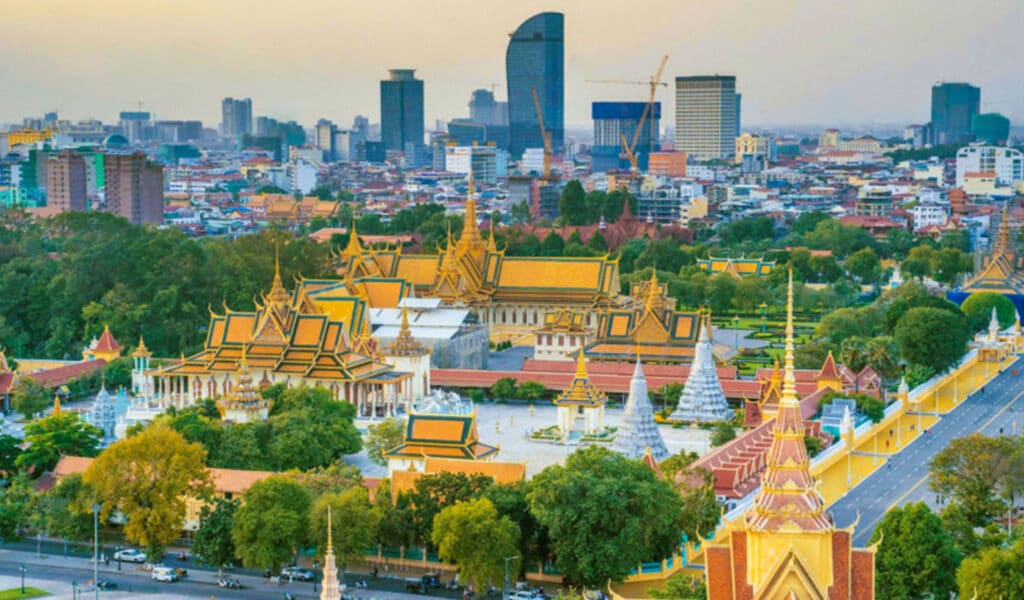
Phnom Penh is one of Southeast Asia’s most underrated capitals, and an essential chapter of any honest Cambodia travel guide. The city sits at the confluence of the Mekong and Tonle Sap rivers, and its waterfront — the Sisowath Quay — is one of the finest urban riversides in the region, alive at every hour with vendors, monks, families, and travelers watching the water change color through the day.
The Russian Market and Central Market reveal the city’s commercial soul — stalls piled with silk, silverware, street food, and the extraordinary variety of Khmer craft that has survived centuries of upheaval. The National Museum, housed in a beautiful traditional Khmer building near the Royal Palace, contains the finest collection of Khmer sculpture in the world, and deserves far more time than most first-time visitors allow it.
Phnom Penh also holds Cambodia’s most difficult history at the Tuol Sleng Genocide Museum and the Choeung Ek Memorial. These places are not easy to visit — but they are essential. No Cambodia travel guide that skips them does justice to the country or its people.
The Journey Across Landscapes

The roads between Cambodia’s cities are part of this Cambodia travel guide, not just the spaces between its chapters. Traveling overland from Phnom Penh to Siem Reap — whether by road or along the Tonle Sap by boat — reveals a country of extraordinary rural beauty that most short itineraries never reach.
Rice paddies stretch to every horizon in the wet season, vivid green under enormous skies. Sugar palms stand at intervals like punctuation marks in a landscape that has looked essentially the same for five hundred years. Villages of wooden houses on stilts appear and disappear, each one a brief glimpse of daily life conducted entirely outdoors — cooking, washing, resting, and talking in the shade beneath the floorboards.
In the northeast, the highlands of Mondulkiri and Ratanakiri add forest, waterfalls, and elephant sanctuaries where rescued animals move freely through jungle that feels genuinely remote. For practical travel planning across these regions, the Tourism of Cambodia official website provides up-to-date entry requirements, regional guides, and transport information every first-time visitor needs.
Food and the Culture of Eating

Khmer cuisine is one of Southeast Asia’s most distinctive and most underappreciated culinary traditions, and deserves its own dedicated section in any Cambodia travel guide. Where Thai food burns and Vietnamese food brightens, Khmer cooking balances — flavors layered with lemongrass, galangal, kaffir lime, and the deeply savory fermented fish paste called prahok that underpins much of the national kitchen.
Amok — fish or chicken steamed in coconut cream and kroeung spice paste, served in a banana leaf — is the dish most often cited as Cambodia’s national dish, and rightly so. Eaten in a simple riverside restaurant in Siem Reap or Kampot, with a cold Angkor beer and the sound of the street outside, it is one of the most satisfying meals in Southeast Asia.
The street food culture of Phnom Penh and Siem Reap rewards slow, hungry exploration. Bai sach chrouk — pork and rice served at dawn from carts outside morning markets — is the breakfast that sets every day in Cambodia on the right footing. For a deeper cultural experience woven into your meals and movements, explore our Ultimate Cambodia: Culture & Beach tour which covers the country’s finest food regions alongside its most iconic landscapes.
Hidden Gems and Off-Beat Places
The most rewarding section of any Cambodia travel guide is always the one most travelers skip. Kampot — a small riverside town in the south, famous for its pepper and its extraordinary colonial architecture slowly being reclaimed by vines — is perhaps the finest example of a Cambodian town that rewards doing nothing in particular with extraordinary generosity.
Kep, a short distance from Kampot, was once a French colonial beach resort whose abandoned villas now stand among the trees like beautiful ruins. The crab market at the end of the seafront road — where the morning catch is cooked to order at open-air tables directly above the water — serves what may be the finest crab in Southeast Asia, eaten simply with Kampot pepper butter.
Battambang, Cambodia’s second city, has the finest surviving colonial architecture in the country and a thriving arts scene that has quietly made it one of the most creative cities in Southeast Asia. For more inspiration on traveling beyond the tourist trail, our Cambodia inspiration guides reveal the hidden stories behind the country’s most rewarding destinations.
Leaving With Echoes of Continuity

Departing Cambodia is never quite what first-time visitors expect. The country that greeted you with famous ruins and complex history leaves you with something quieter and more personal — a river reflection held in memory, a conversation with a tuk-tuk driver that lasted longer than expected, the smell of frangipani at dusk outside a temple wall.
The most enduring quality of Cambodia — the one that makes every Cambodia travel guide ultimately insufficient — is the warmth of its people. A country that has survived extraordinary suffering with its humor, generosity, and dignity intact is not simply a destination. It is an argument for something important about human resilience.
Cambodia does not end when you leave. It continues in the way you notice light falling on stone walls, in the patience you carry home without quite realizing, in the quiet certainty that you will return. Every honest Cambodia travel guide ends the same way — not with a conclusion, but with a reason to come back. When that reason calls, our team is ready — plan your Cambodia tour and let us craft the journey you deserve.


